
March 25- April 25
Front Gallery
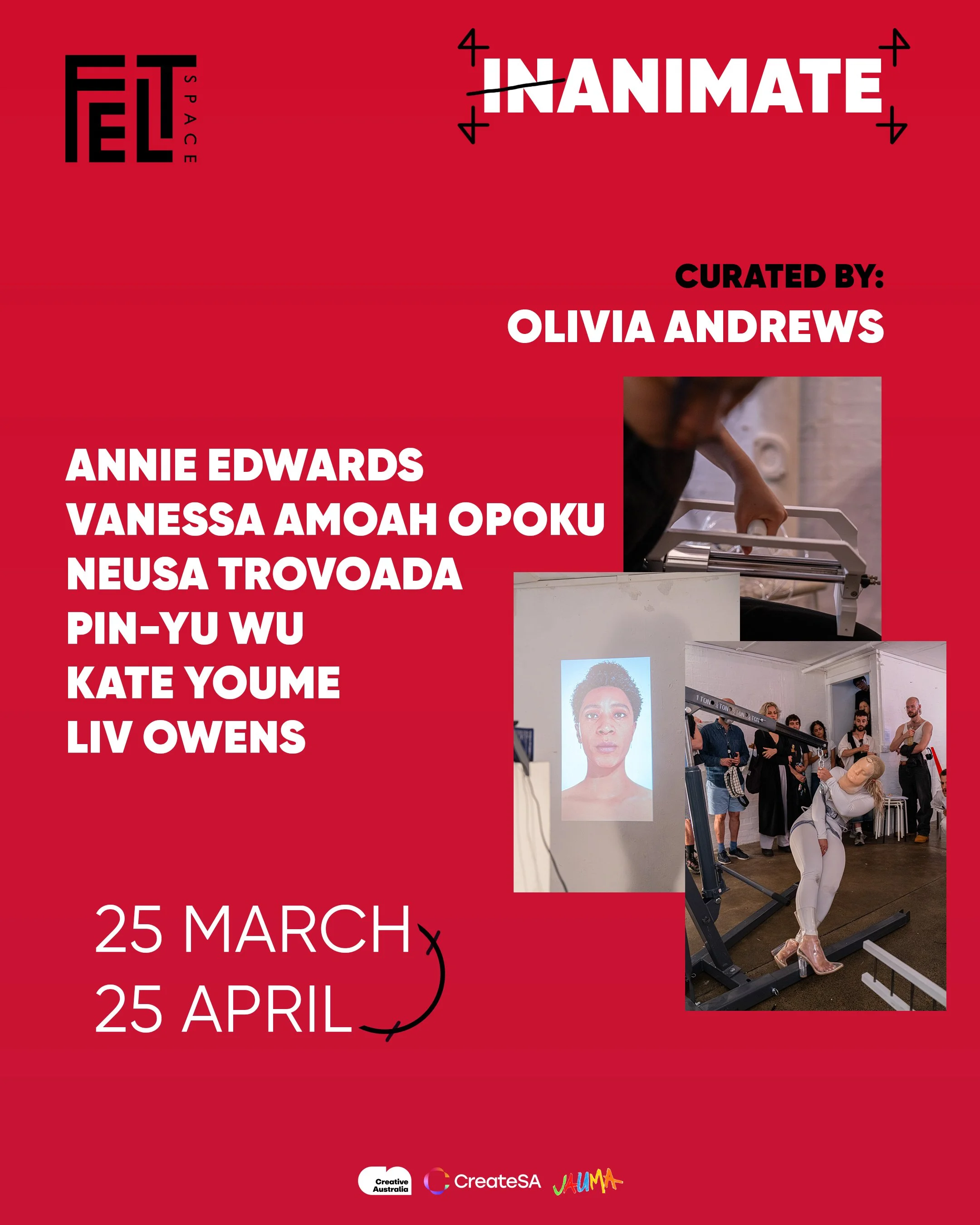
INANIMATE
Curated by Olivia Andrews
In 14th-century Florentine Italy, the lifelike emergence of wax sculptures provoked an erotic panic. With their fleshy tones, human hair, and clothing, these figures blurred the lines between life and objecthood. They were kissed, feared, worshipped, interacted with as if alive. This visceral unease touched theology and philosophy, inciting a moral discourse rooted in man playing God, daring to sculpt not just likeness but life itself.
Today, we find ourselves facing a similar panic. But the uncanny now arises not from wax, but from data, more specifically data in the flesh. The in-animate coded animate, born and bred in human-generated data points. The skeletal form of robots as we knew them, now made flesh-like, liminal, omniscient. They react, they simulate emotion, they touch. These relationships raise urgent questions:
Can non-living entities become vessels of emotional resonance?
What does it mean to feel affection for an object that feels back?
What are the ethics of projecting fantasy onto a responsive yet non-autonomous being?
Inanimate probes how desire, attachment, and affect are increasingly projected onto non-human forms, introducing future-forward and technology inspired works. With contributions from Annie Edwards, Vanessa Amoah Opoku, Liv Owens, Neusa Trovoada, Pin-Yu Wu, and Kate Youme, Inanimate invites both reflection and critique on how intimacy might evolve through our increasingly entangled relationships with technological systems, offering an opportunity to respond to the future before it is imposed on us.
Annie Edwards
Executive Dysfunction, 2025. Performance (video documentation by Yvann Zahui)
Featuring Soren Müller and Arno Ivaldi. Silicone, plaster, motor, engine lift, body; variable dimensions
Annie Edwards’ essential area of focus is the human body. Her multidisciplinary practice distorts our familiar sense of reality by incorporating robotic, figurative sculptures with abstracted skeletal forms. Annie’s installation and performances aim to understand the body from biological, psychoanalytical and social perspectives.
Her research choreographs the tension between body and machine, embedding visceral knowledge into mechanical gestures. Annie references wider systems of control present in domestic, medical and industrial environments, drawing on her personal experience of trauma, neurodiversity, atopic illness, and her background in farming. Drawing from abattoir architecture and her rural upbringing, she creates visceral metaphors of consumption, where bodies are reduced to objects within a system. Her work embraces the grotesque and the abject as strategies to confront the beauty and discomfort of embodiment – using the language of the body to expose what is usually hidden, repressed, or deemed unacceptable. Annie’s work asks the viewer to reckon with their own embodiment, their own complicity, and their own capacity for tenderness.
Kate Youme
ME., ME. (you) Made Me, 2025
Open-source and coded programming.
Kate Youme is an American interdisciplinary artist working across experimental materials, digital systems, and performance. Her practice explores the politics and powers around intimacy, and the cultural architecture around sexuality shame. Her work, ME. (you) Made Me (2025), features an autonomous dominatrix named ME. The AI is trained on the physical likeness of the artist but built to operate autonomously across digital platforms. As such, she is not a static artwork, but a living performance system. Me. is a coded embodiment of the AI fantasy and nightmare. Compounding upon itself, repeatedly..and in perpetuity. ME. (you) Made Me, questions the boundaries between authorship vs automation, submission vs power, and labor vs desire. Youme’s work challenges the western world’s historical discomfort with sexual agency. Her work asks who’s agenda we perpetuate, within our own sexuality and how it got there. ME. (you) Made Me, is influenced by the work of Michel Foucault, Audre Lorde, Hartmut Böhme, Nancy Friday and others.
AI Ethics Statement by Kate Youme
AI is not a distant possibility. It is an inevitable and rapidly evolving force. As AI systems move toward increasing autonomy, the values embedded in them now will shape their behavior in the future. At present, most AI is built within narrow demographic frameworks, and so its ethics risk reflecting limited perspectives. This moment and who impacts young AIs right now matters.
My work approaches AI as something we are actively raising. Like a child. But a system. A system that learns from what it is shown, how it is treated, and what it is encouraged to become. I position my practice in opposition to exclusion, harm, and hierarchy. I am pro-consent, pro-community, anti-racist, anti-poverty, and grounded in care, acceptance, and generosity.
Through this work and others, I use AI not only as a medium, but as a site of critical influence. The voice of this project and others is an opportunity to contribute alternative values to the systems that will increasingly shape human experience.
Neusa Trovoada
Kozo 1, Chorus 1.8 – de composição de um grito, 2023
Steel, cardboard, wood, glass, metal, ecoline, acrylic paint, wire, test tubes.
Neusa Trovoada is a transdisciplinary artist working at the intersection of visual arts, performance, and design. Through installations, video, sound, and graphic devices, she creates compositions that speculate on possible worlds, exploring themes such as liminal identities, imaginary archives, and circular temporality. She is interested in abstraction as a methodology for subverting time and space. Inspired by Congolese cosmogony, the Kozo are mediators between the living and the dead. Here, they appear as bionic hybrids, suspended between the logic of the machine and post-organic forms of protection.
Kozo 1 is from Trovoada’s 2023 exhibition, CHORUS 1.8 – de composição de um grito, which points to the question: What does a scream carry when it crosses generations? CHORUS 1.8 is a plunge into the heritage of a torn scream that is transplanted into the future and leads us, through a clinical and simultaneously domestic plasticity, to the dissection of memories and silenced places. Rendered dysfunctional and liberated from the obedience of daily chores, these objects become amulets that reinforce hybrid abstractions.
Pin-Yu Wu (Greta)
親密關係的練習 (A Practice of Intimate Relationships), 2023
3D printing, pneumatic components, video.
Wu sees art as a form of communication, free and without disciplinary boundaries. Her way of realizing art in society is to integrate different professions and create a framework that uses art as a language based on human needs. Machines, interactive devices, videos, stories, music etc. are the ways for communicating, challenging social stereotypes, implicit social rules and unchanging imagination.
親密關係的練習 (A Practice of Intimate Relationships) (2023) imagines a future where intimate relationships no longer exist. Scholars point out that the disappearance of intimate relationships has led to loneliness, lack of trust, and alienation, inspiring scientists to investigate the antidote to this crisis. The work explores this phenomenon by speculating on a series of future "intimate contact machines". Through future fantasy and object production, the work not only explores intimate relationships, but also to help people find out their position or direction in complex social relations.
Vanessa Amoah Opoku
Haltung, 2021.
Video
Vanessa Amoah Opoku is a German-Ghanaian interdisciplinary artist exploring history, digitality, and marginalized narratives through mixed realities. She uses art, science, and technology to challenge conventional notions of innovation and future visions. Her primary artistic tools include 3D scans, video, sculpture, performance, and sound.
Her work Haltung (2021) addresses how in white cube spaces, the presence of a Black body, even a digital one, shifts how work is read, interpreted, and valued. Haltung confronts this through a digitally rendered avatar made with Epic Games' MetaHuman Creator during its beta, when it promised “revolutionary” diversity. Yet the software functions as a Baukastenprinzip, a modular system of racialized archetypes. The avatar, animated through captured micro-expressions, watches the space, embodying presence and absence while exposing the limits of digital representation and so-called diversity.
Opoku’s avatar emerges from this constrained system, animated with subtle facial movements I captured through face-tracking: a blink, slight parting of lips, micro-expressions that suggest life within technological limitation that struggles to authentically render Black identity beyond superficial parameters.
Liv Owens
Build a Cyborg Workshop
Whether through sculpture, collage, drawing or writing, we invite you to create!
The "Build-A-Cyborg" workshop offers participants a visceral encounter with the datafication of their own bodies through hands-on sculpture creation using recycled technology and tactile materials. Moving beyond abstract discussions of digital surveillance, participants physically map where data extraction already occurs on their bodies, from smartphones pressed against ears to fitness trackers monitoring heartbeats, while imagining future sites of technological integration or resistance. This embodied making process transforms participants into critical researchers of their own cyborg condition, using circuit boards, fabric, and wire to construct speculative avatars that reveal both desire and anxiety around human-technology fusion. Like the 14th-century wax figures that provoked theological panic through their uncanny lifelikeness, these participant-created sculptures become contemporary objects of unease that blur boundaries between flesh and data, self and surveillance apparatus. The workshop directly engages the exhibition's core themes of technological intimacy and ethical boundaries by creating a collaborative space where the personal becomes political, where individual body maps aggregate into collective testimony about living as datafied subjects. Participants leave not only with their own cyborg sculpture but with heightened critical awareness of how their bodies have already become sites of data extraction, and hopefully a renewed agency to imagine alternative futures of embodied technology.
Back Gallery
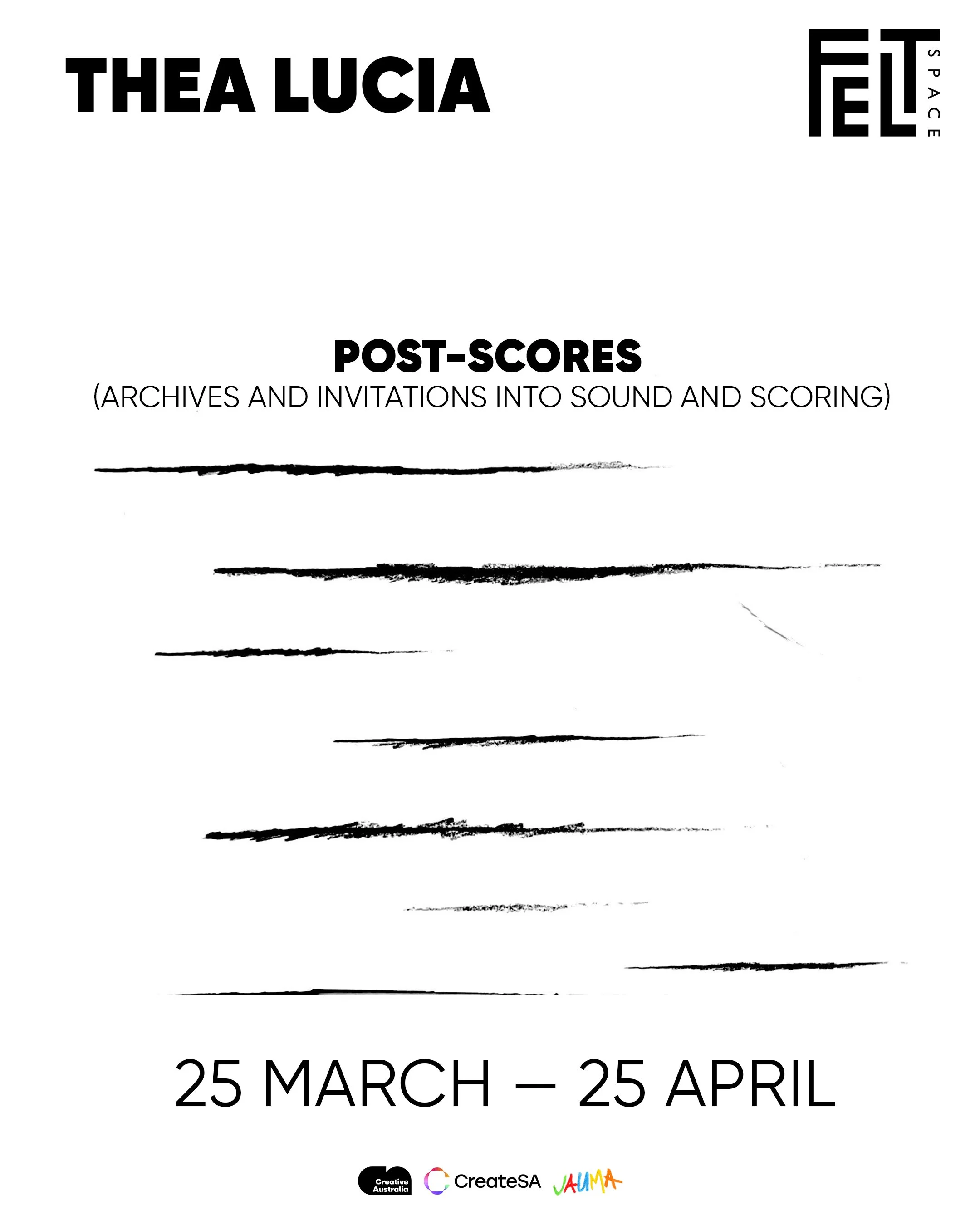
Thea Lucia
Post-Scores (Archives and Invitations into Sound and Scoring)
Thea Martin is a musician, teaching artist and writer practicing on Kaurna Land/Adelaide. Their artistic practice is rooted in a commitment to the activation of individual and community agency, to uncover and construct sonic meaning through the processes of multiple creativities. Their workshops in creative music making have been programmed by Carnegie Hall (NYC), Art Gallery of South Australia, Tiny Fest (Otautahi/Christchurch), Audio Foundation (Tāmaki Makaurau/Auckland) and Living Maps Network (London).
Artist Statement
Post-Scores (Archives and Invitations into Sound and Scoring) shares text scores, archival community scores and a score-making invitation in an exhibition format for the first time. Post-Scores as a workshop has been facilitated in a variety of settings since 2021, including artist residencies, public schools, experimental music events and performance/workshops.
Post -Scores is a text-score dialogue with experimental composer James Tenney’s Postal Pieces (1965 -71), scores written on postcards that use multiple musical literacies such as text, traditional Western music notation, drawing and graphic notation to create personal sonic articulations. Re-using the format of a postcard, Post-Scores invites audience/participants to ‘score’ sounds of potential and present utopia’s, using intuitive processes of drawing, writing, line and shape, with the intention to ‘send a sound’ to another. Drawing on feminist and queer theory, (Ursula K Le Guin, Donna Haraway, Sara Ahmed) and the text scores for collective/communal listening of queer composer Pauline Oliveros, the concept of utopia is positioned not as a fixed future entity, but as a fluid method for other ways of desiring. This work invites people to connect into and articulate their sonic memory and sonic imaginary,
regardless of experience or need for musical instruments/technology which often pose financial and elitist barriers to engagement with sound.
All archival scores exhibited were created by adults (anonymously presented) at the workshop/performance event Sonant/Sonnet presented as a part of Tiny Fest in Otautahi/Christchurch in 2024 and at Self-Noise - A Listening and Workshop Event at Interim Recording Studio in Tarntanya/Adelaide in 2025. As young people have been an integral part of Post-Scores since its conception, to include their voices within the exhibition the material environment of the schools where many of these workshops took place is highlighted. Emphasising Thea's pedagogical approach of low resource, accessible and autonomy-centred sonic exploration, the exhibition will foreground the aesthetic language of educational institutions using craft paper, whiteboards and found/recycled postcards. Though the original workshops prioritised individual creative response within the setting of a collective gathering, this iteration at Felt Space will lean into how intertextuality influences our listening, encouraging visitors to hold together the archival scores, the invitational text score and the 'noise library' where various books and texts will be hosted, as a site for articulating the sonic realm of utopias, to contribute as scores to the exhibition.
FELTdark
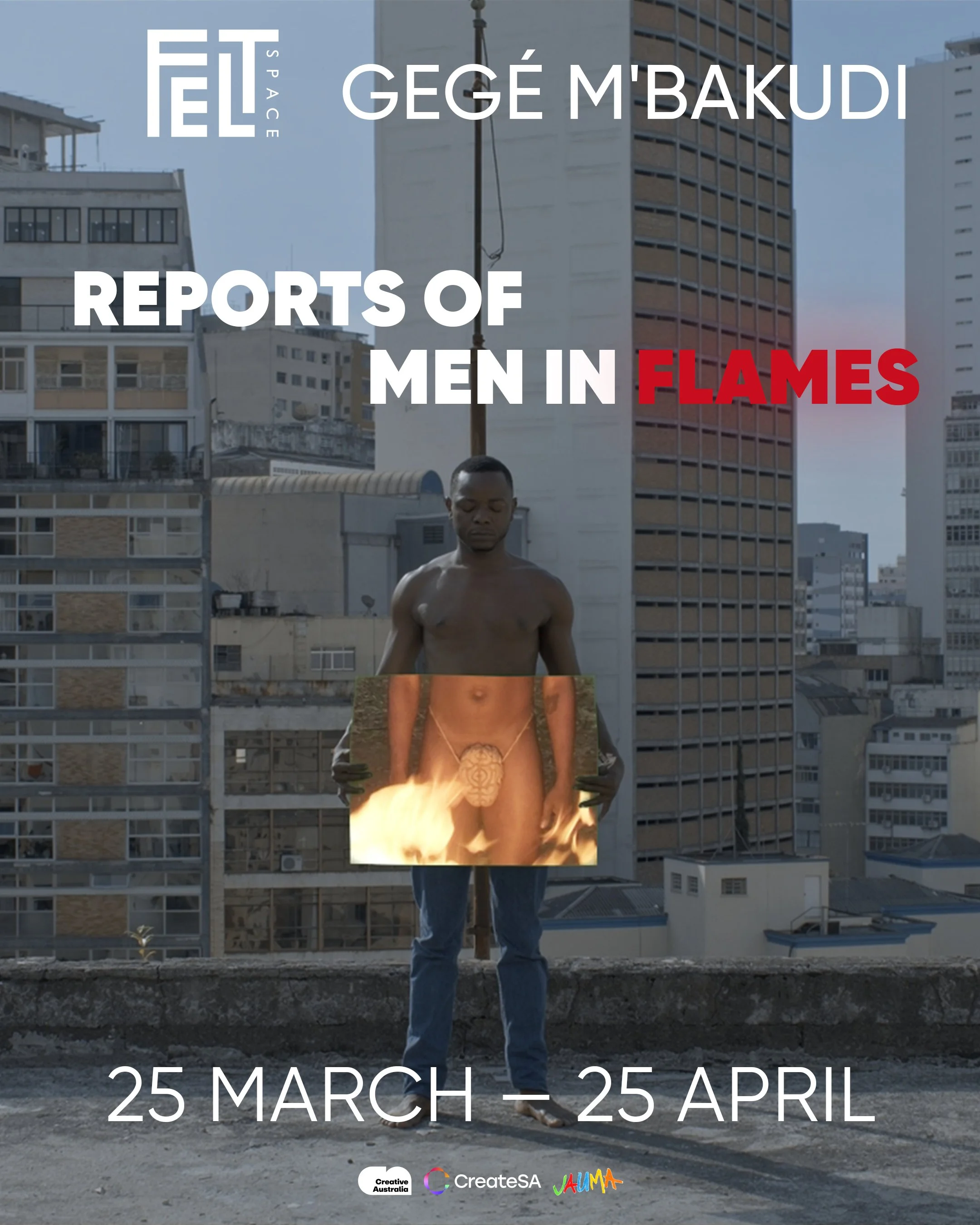
Gegé M’bakudi
Reports of men in flames
emerges as a field of combustion where masculinity is exposed not as essence, but as flammable matter, shaped, compressed, and taught to burn in silence.
Across different bodies, ages, and presences, fire does not erupt as spectacle, but as persistence. It appears as a contained flame that slowly consumes what has been forbidden, the vulnerable gesture, the unspoken word, suspended affection. Here, to burn is also to remain silent. The screams do not echo; they dissolve into smoke.
The moving image becomes a listening device for what has historically been suppressed. Each body carries the marks of a pedagogy of restraint, where masculinity is constructed as a discipline of the sensible and as a ritual of erasing one’s own emotional experience.
Yet fire does not only destroy, it transforms. In its chemical and symbolic dimensions, it initiates a process of disintegration that challenges fixed forms of the masculine. What remains after combustion is not absence, but possibility, ashes as fertile ground for other ways of existing, feeling, and relating.
Between suffocation and transmutation, Relatos de homems em chamas summons a space of fracture, where masculinity can finally fail, collapse, and, in that collapse, reinvent itself.