JUNe 17 - JULY 18
Front Gallery
Astrolabe
Emmalyn Hawthorne
Artist Statement
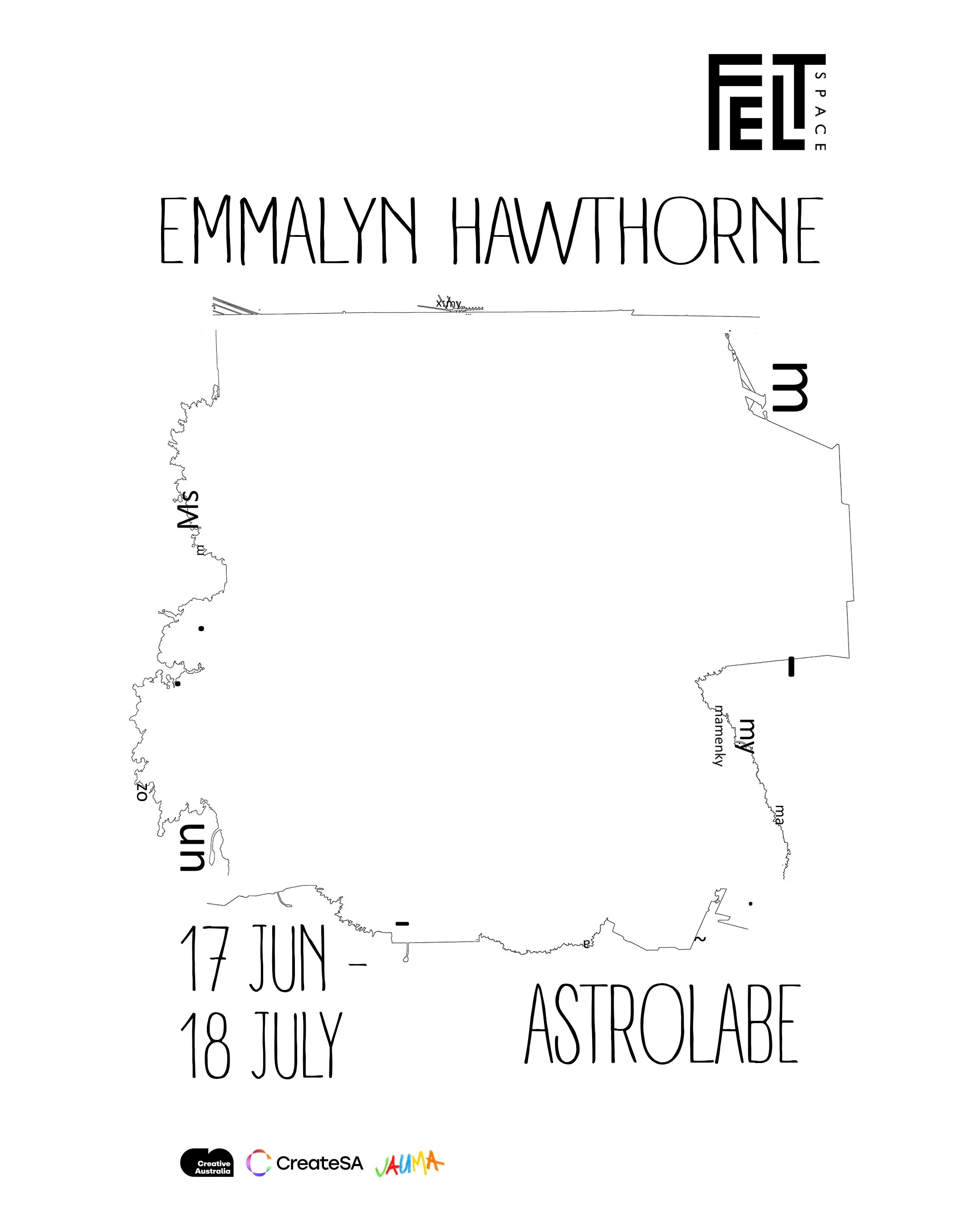
Astrolabe is an ongoing project that uses a combination of Optical Character Recognition software (OCR) and 3D printing to ‘read’ skylines and create site-specific models of the output. The OCR interprets the skyline as though it was handwriting, comparing the curves and angles to its database of written text. Sometimes jumbles of letters and punctuation come out and other times whole words or phrases (poems). For FELTspace, Astrolabe engages with four skylines surrounding the front gallery. Each sculpture is installed in alignment with the skyline that generated it.
Skylines and words are similar in that the way we perceive them depends upon our own positioning within both physical and cognitive landscapes. Always in flux, they evolve and morph as we interact with them over time. 3D printing gives form to these histories — layering a thin line of filament across a surface like stacking pages of writing.
An astrolabe is a hand-held astronomical instrument, a rudimentary analogue computer, used for reckoning time and making measurements that enable the user to orientate themselves both on Earth and within the celestial sphere. These works are intended to afford a similar means of orientation and understanding, charting lines back through times, perspectives, and our, frequently destructive, use of the landscape and of words.
Back Gallery
Wist
Grace Surmon
Ceridwen Boldock-Eliott
Tahneisha Satori Mottishaw
Katarina-Anna Ongal
artist statement
Across 2025 local film maker Bryce Kraehenbuehl (with the support of artist Allison Chhorn and the Port Adelaide and Enfield Council) ran a series of workshops to nurture a new crop of creatives utilising analogue motion film. A caveat was that the footage had to be shot within the boundaries of the Port - and for several participants this would prove pivotal.
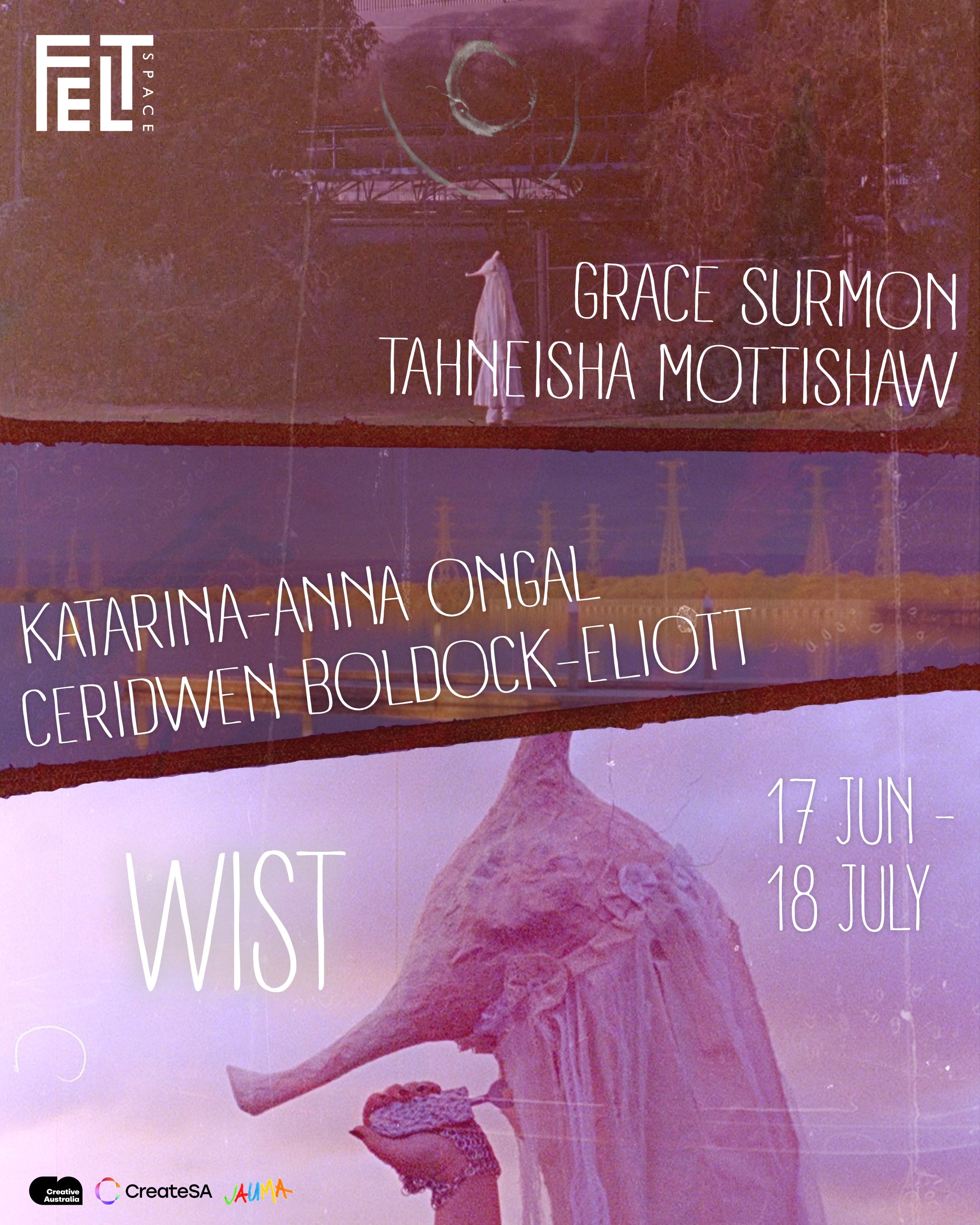
“Wist” is an immersive installation featuring the 16mm film of the same name, props, sculptures and photography seeking to capture our vision of the port and it’s melancholy co-existence between industry, domestic spaces and nature. None of us had a history with the area before beginning work on “Wist" so we explored entirely through the lens of experimental practice.
Empty buildings sit next to cosy homes, themselves next to soon-to-close warehouses all framed by encroaching, hardy natural life. Through our camera and our hands these lonely spaces are re-enchanted, made beautiful and strange. The Port is in a constant state of ‘regeneration’ but who does it serve? What makes a space desirable, liveable... home? Undead sea creatures are the inhabitants of these reimagined industrial ruins - their bodies filtered through through the aesthetics of natural history museums and folk revivalism.
We invite visitors to step into a surreal fantasy shaped by local psychogeography - eroded, warped and yet familiar.
Bio
“Wist” features work from four emerging, multi-disciplinary Kaurna based artists.
Ceridwen Boldock-Eliott’s work is based around the forms and textures that come from repetition and time - the meditative labour used in making traditional artworks has a strong influence on their practice. Their work has been featured in “The Danse Macarbe” for SALA (2024), and “Germ” for SALA (2025).
Tahneisha Satori Mottishaw is a Visual Arts student studying at AC Arts who experiments in primarily 2D based practices. Their passions lie in themes such as identity, technology, connection and pushing and pulling the human form.
Katarina-Anna Ongal has completed a Bachelor of Media with a major in Sonic Arts at the University of Adelaide, providing her an academic background with sound design, sound engineering and creative media mediums such as photography, graphic and digital design, and film. Katarina continues to self-teach herself sound design, film, textiles, mixed-media and visual art. One of her biggest passions and endeavours is connecting the community through art.
Grace Surmon’s practice centres on folklore, natural history, archeology and ephemera. She was awarded the Flinders University Medal upon completion of the Bachelor of Creative Arts (Visual Effects and Entertainment Design) Honours. Hauntology and psychogeography as both aesthetic sensibilities and thematic elements underly her work - aiming to capture how the sedimentary layers of history (both personal and monumental) bleed into physical spaces.
FELTdark
Ulvi Haagensen
The Portable Garden
Artist statement
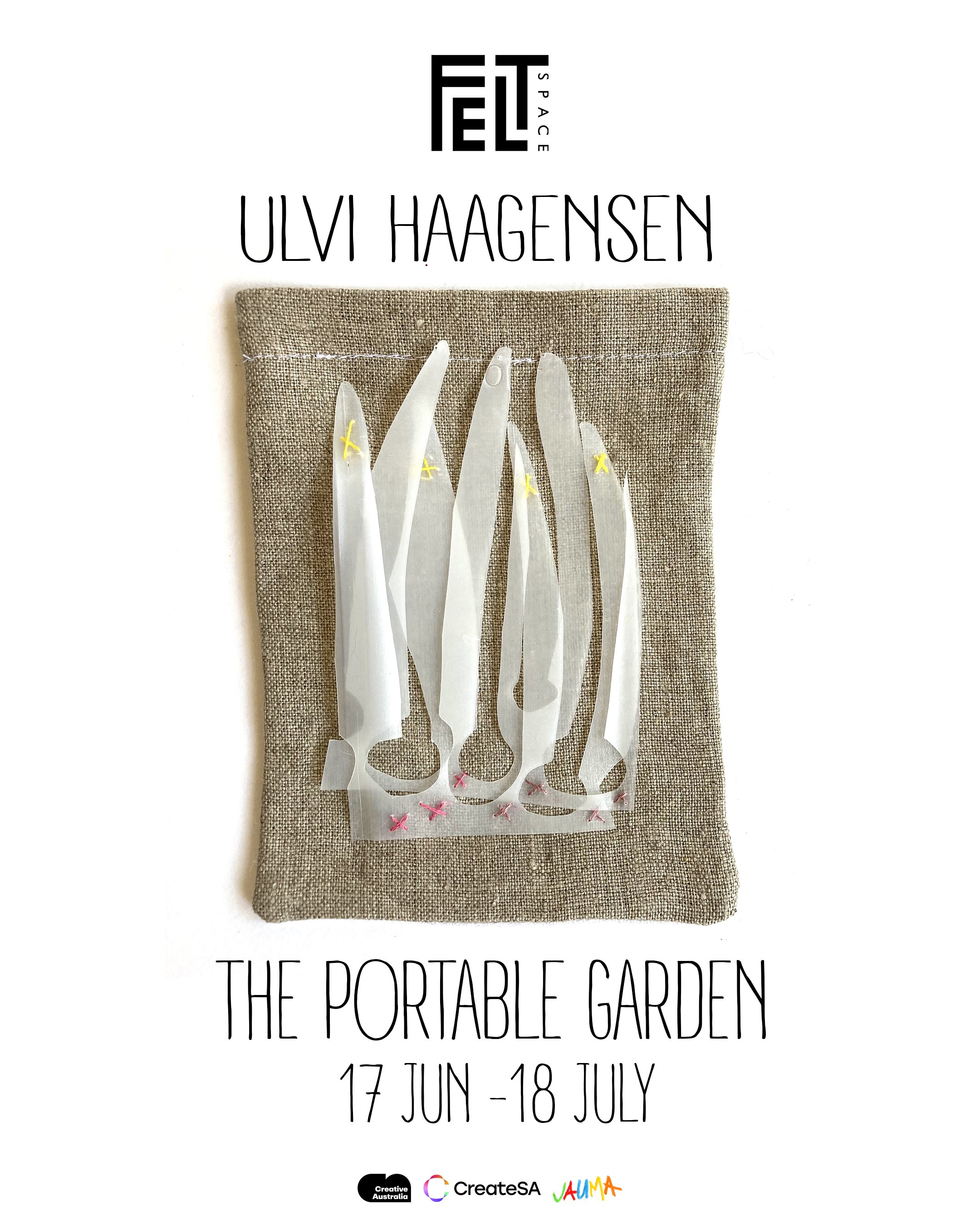
Agnes-Maria Aednik is my imaginary gardening friend and together we practice transitory light-footed gardening. We want to know if it is possible to be a gardener even when you feel untethered, when you have no land and don’t feel you belong in any specific place, and in her case when you don’t exist. We are under no illusions about gardening being easy – digging, watering, weeding, keeping things in order, hoping and encouraging, is hard work. So, to do it well and joyfully we have equipped ourselves with a 5 kg bag of potting mix and plenty of seeds, seedlings and all kinds of tools and equipment. But we also have a generous supply of curiosity. We hope that by being open and allowing things to unfold we can learn how to be better human beings.
Bio
Ulvi Haagensen, born Sydney, Australia, has been based in Tallinn, Estonia for many years. Her art practice combines installation, sculpture, drawing and performance with everyday practices like domestic cleaning and gardening to explore the blurred edges between art and everyday life. In 2025 she returned to Sydney after completing her PhD in artistic research at the Estonian Academy of Arts. She is currently studying for a diploma in library and information services as part of her plan to reassimilate back into life in Australia.